Chrome dumbbells bring the shine, while rubber dumbbells are built for the daily grind. The short answer? Chrome wins for looks and compactness; rubber wins for noise control, floor protection, and busy gyms. Keep reading to compare durability, cost, and which of our best-selling dumbbells fits your facility.
Quick Answer
Chrome vs rubber dumbbells: which is better?
For most commercial gyms, rubber dumbbells are the safer all-around buy. They are quieter, more forgiving around flooring, and better suited to a room where dozens of people may handle the same pair every day.
Chrome makes more sense when appearance and compactness are higher priorities. Boutique studios, personal training spaces, and polished hotel gyms can benefit from the cleaner metallic look.
What is the difference between chrome dumbbells and rubber dumbbells?
The biggest difference is what surrounds the weighted head. Chrome dumbbells expose a hard plated metal surface, while rubber dumbbells use a protective rubber coating around the metal core.
That one design change affects noise, impact protection, head size, cleaning, and how the dumbbells look after years of use.
Which looks better in a commercial gym?
Fresh out of the box, chrome is hard to beat. A matching chrome rack can make a free-weight area look bright, clean, and carefully designed.
Rubber is less flashy, but it fits modern commercial gyms extremely well. Black rubber heads also hide everyday use more easily than a reflective metal surface.
Which lasts longer in a commercial gym?
Both can last for years if the dumbbells are commercially built. Rubber, however, tends to cope better with ordinary bumps, rack contact, and members who are not exactly gentle when returning a pair.
Which is better for commercial gyms: chrome or rubber dumbbells?
Rubber is generally better for high-volume facilities. Chrome is better suited to controlled spaces where members are less likely to drop dumbbells and staff can keep the equipment looking polished.
Quick recommendations by facility type
General health club: rubber. Boutique studio: chrome or rubber. Hotel or apartment gym: usually rubber because noise matters. Bodybuilding gym: either, depending on the required weight range and preferred dumbbell style.
What Are Chrome Dumbbells?
What is a chrome dumbbell?
A chrome dumbbell is a fixed dumbbell that uses a polished chrome finish on the head, handle, endcaps, or a combination of these parts. The result is the familiar bright metallic look found in many traditional weight rooms.
How chrome dumbbells are made
Construction varies. Some chrome dumbbells use solid steel, while others use cast components with chrome plating applied over the surface.
Solid steel vs cast iron chrome dumbbells
Solid steel is dense, which can help manufacturers keep the dumbbell head relatively compact. Cast iron is also commonly used in strength equipment, but the shape and overall dimensions may be larger depending on the design.
How chrome plating works
Chrome plating adds a hard decorative surface over the underlying metal. Unlike rubber, it does not provide much cushioning when the dumbbell hits a rack or floor.
Decorative chrome vs hard chrome
Not every shiny dumbbell uses the same finish. For commercial buyers, the important questions are how well the plating holds up, whether the dumbbell is actually rated for commercial use, and what warranty supports it.
Chrome heads vs chrome handles
This is an easy detail to miss. Plenty of rubber dumbbells still use chrome handles, so the phrase “chrome dumbbell” should normally refer to the construction of the head rather than the grip alone.
Chrome pro-style dumbbells
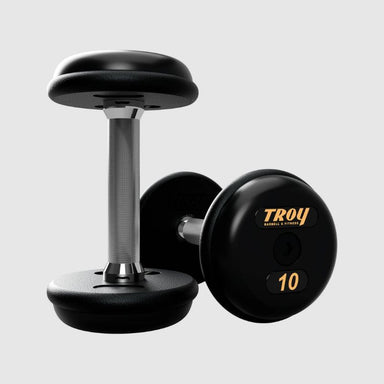
Pro-style dumbbells often use round heads with chrome endcaps. They have a classic bodybuilding-room appearance and can be paired with straight or contoured handles.
Typical chrome dumbbell weight ranges
Chrome dumbbells are common through lighter and medium commercial ranges. Heavier weights are available too, particularly in pro-style formats.
Why chrome dumbbells have compact heads
Because there is no thick rubber layer surrounding the weight, chrome designs can often stay smaller at the same listed weight. That becomes especially noticeable once you move into heavier dumbbells.
Who should choose chrome dumbbells?
Chrome is worth considering for boutique studios, upscale fitness rooms, personal training spaces, and gyms where visual presentation is part of the experience.
What Are Rubber Dumbbells?
How rubber dumbbells are constructed
Most rubber dumbbells have a metal core with a molded or bonded rubber exterior. The rubber does not create the weight; it protects the weighted head and surrounding surfaces.
Rubber-coated steel or cast iron cores
The internal material varies by product. What matters commercially is that the head is securely connected to the handle and the coating is durable enough for repeated use.
Virgin rubber vs standard rubber
Different rubber compounds can feel, smell, and wear differently. A commercial buyer should compare the actual manufacturer specifications instead of assuming every rubber dumbbell performs the same.
Rubber hex dumbbells
Hex heads are popular because they resist rolling. That makes them useful for general lifting, floor exercises, and small training areas where a rolling dumbbell can become an instant trip hazard.
Round rubber dumbbells
Round rubber dumbbells offer the familiar commercial-gym profile while still giving the floor and rack some protection.
Multi-sided rubber dumbbells
Eight-, ten-, and twelve-sided designs sit somewhere between round and hex. They resist rolling without always looking as utilitarian as a basic hex dumbbell.
Rubber-coated pro-style dumbbells
For gyms that like the traditional pro-style shape but want more protection, rubber-encased versions are a useful middle ground.
Typical commercial rubber dumbbell weight ranges
Rubber is available across a very broad range, from lighter pairs to full 5–100 lb commercial sets and heavier specialty options.
Why rubber dumbbells dominate many commercial gyms
They simply make daily gym life easier. They are quieter, more forgiving around flooring, and available in enough shapes and weight ranges to suit almost any member base.
Who should choose rubber dumbbells?
General commercial gyms, schools, hotels, apartment fitness centers, corporate gyms, and busy personal training studios are all strong candidates.
Chrome vs Rubber Dumbbells: What’s the Difference?
Chrome plating vs rubber coating
Chrome creates a hard metallic exterior. Rubber adds a softer protective layer around the weighted head.
Appearance
Chrome is brighter and more decorative. Rubber has a cleaner, darker look that fits modern strength areas.
Head size
Chrome usually has the advantage here because the head does not need a thick outer coating.
Head shape
Rubber provides more variety, including hex, round, multi-sided, and pro-style designs.
Weight range
Both can cover common commercial weight ranges, although rubber is especially easy to find in complete rack packages.
Durability
A well-built commercial model of either material can last for years. The quality of the handle connection and core construction matters just as much as the outer finish.
Floor protection
Rubber wins. It does not make a heavy dumbbell harmless, but it softens the contact compared with exposed metal.
Noise
Rubber also wins here. A row of chrome dumbbells hitting metal rack saddles during rush hour can get loud quickly.
Grip and handle feel
This depends more on the handle than the head. Knurling, handle diameter, and straight versus contoured designs have a bigger effect on grip.
Rubber odor
New rubber can have a noticeable smell. Good ventilation usually makes it much less noticeable over time.
Scratches
Chrome scratches tend to stand out because the surface is reflective. Rubber usually shows scuffs instead.
Chipping and flaking
Chrome plating can chip after repeated hard impacts. Lower-quality rubber can eventually crack or separate from the core.
Rust and corrosion
Chrome helps protect the underlying metal, but scratches or chips can expose it to moisture.
Cleaning
Both materials are easy enough to maintain with suitable cleaners. Chrome tends to show fingerprints more readily.
Maintenance
Rubber usually demands less cosmetic attention in a busy gym.
Price
Brand, weight range, construction, handle design, rack package, and freight all influence final cost.
Long-term value
For most shared commercial facilities, rubber offers the stronger practical value. Chrome can still be worth the investment when aesthetics are central to the space.
Chrome vs Rubber Dumbbells: Head-to-Head Comparison
Which looks better?
Chrome for visual impact.
Which stays looking new longer?
Rubber often hides routine commercial wear more gracefully.
Which lasts longer?
There is no automatic winner. Commercial construction matters more than the finish alone.
Which handles high-volume commercial use better?
Rubber is more forgiving.
Which protects floors better?
Rubber.
Which is quieter?
Rubber.
Which is more compact?
Chrome.
Which is easier to clean?
Both are manageable, but rubber does not show every fingerprint.
Which is better for heavy dumbbells?
Compact chrome or pro-style designs can become attractive as weights increase.
Which is better for boutique gyms?
Chrome has a clear visual advantage.
Which is better for high-traffic gyms?
Rubber is the safer bet.
Which provides better overall value?
For most commercial facilities, rubber gives the better balance of durability, noise control, floor protection, and cost.
Which Looks Better: Chrome or Rubber Dumbbells?
The polished chrome look
A fresh chrome rack immediately catches the eye. In a mirrored boutique gym with bright lighting, it can almost look like part of the interior décor.
The modern commercial look of rubber dumbbells
Rubber does not sparkle, but that is often the point. Black heads pair naturally with racks, flooring, benches, and plate-loaded machines.
Reflective chrome in bright gym interiors
Chrome works particularly well when a room uses lighter colors, mirrors, and polished finishes.
Black rubber in modern strength areas
Rubber looks right at home in darker industrial-style free-weight areas.
How an entire rack changes the appearance
Material is only half the story. Twenty matching pairs arranged neatly on the right rack will look far better than mismatched dumbbells, regardless of coating.
Chrome dumbbells in boutique studios
They can reinforce a more curated, less warehouse-like atmosphere.
Chrome dumbbells in luxury health clubs
When the room is designed to feel polished rather than rugged, chrome makes sense.
Rubber dumbbells in large commercial gyms
Rubber looks purposeful. In a busy room, that practical appearance is often more appropriate than trying to maintain a showroom finish.
Matching dumbbells with benches and racks
Matching the finish of your dumbbells, rack, and nearby strength equipment creates a cleaner overall presentation.
Does equipment appearance influence member perception?
Absolutely. Members may not know the model number of a dumbbell, but they notice whether the room looks organized, clean, and cared for.
Which looks better after several years of use?
This is where rubber can close the gap. Chrome may look better on day one, but rubber often hides everyday commercial wear more effectively.
Which Lasts Better: Chrome or Rubber Dumbbells?
Usable lifespan vs cosmetic lifespan
A dumbbell can look worn and still be perfectly usable. Commercial buyers should distinguish surface wear from structural failure.
Repeated rack contact
Rubber absorbs some of that daily contact. Chrome tends to advertise every scratch.
Accidental drops
Neither type should be deliberately thrown around, but rubber offers more protection when a member loses control of a pair.
High-volume daily use
If a pair of 30s changes hands all day long, rubber is usually easier to live with.
Chrome scratches
Small scratches are mostly cosmetic, but they are easy to see.
Chrome plating chips
Hard impacts can damage plating and expose the material underneath.
Chrome flaking
Once the finish deteriorates badly, the dumbbell can lose much of the appearance that made chrome attractive in the first place.
Rubber scuffs
Scuffing is common and usually cosmetic.
Rubber cracking
Older or lower-grade rubber can eventually crack, especially after years of abuse.
Rubber separation from the core
Strong commercial construction helps reduce this risk.
Sweat exposure
Both types benefit from regular wiping, particularly around handles and exposed metal.
Humidity
Humidity creates greater concern wherever metal becomes exposed.
Cleaning chemicals
More aggressive is not always better. Harsh cleaners can damage both coatings and plated finishes.
Which remains usable longer?
A properly built commercial dumbbell of either type can provide a long service life.
Which maintains its appearance longer?
Rubber often wins in uncontrolled high-traffic rooms. Chrome can stay beautiful for years in a carefully managed facility.
Why commercial build quality matters more than finish alone
A strong handle connection, accurate head construction, and commercial warranty matter more than whether the outside is shiny or black.
Advantages and Disadvantages of Chrome Dumbbells
Advantages of chrome dumbbells
Sleek polished appearance
This is chrome's biggest selling point. Few dumbbell styles look as crisp when arranged on a matching rack.
Compact dumbbell heads
Smaller heads can make pressing, rowing, and storing heavier dumbbells easier.
No rubber odor
For small enclosed studios, this can be a meaningful advantage.
Smooth, easy-to-wipe surface
Chrome is easy to clean when the correct products are used.
Traditional commercial gym appearance
Chrome also brings a classic health-club and bodybuilding feel.
Attractive for boutique and luxury facilities
If people notice the interior before they notice the squat rack, chrome deserves a look.
Useful for lighter dumbbell ranges
Chrome can be particularly attractive when a facility does not need a huge heavy-weight lineup.
Strong fit for controlled training environments
Supervised studios are less likely to expose the dumbbells to constant dropping and careless re-racking.
Disadvantages of chrome dumbbells
Less floor protection
Metal is simply less forgiving against the floor.
Louder rack contact
A chrome rack can sound surprisingly lively during peak hours.
Louder floor contact
Appropriate commercial flooring becomes important.
Scratches show easily
A reflective finish has nowhere to hide them.
Chrome can chip
Repeated hard impact can damage the plating.
Damaged plating can expose metal
Once exposed, moisture requires more attention.
Fingerprints and smudges are noticeable
The price of shine is more frequent cosmetic cleaning.
Harder contact against the thighs during heavy setup
Anyone who has kicked a pair of heavy dumbbells into position for a bench press knows why rubber feels friendlier.
Advantages and Disadvantages of Rubber Dumbbells
Advantages of rubber dumbbells
Better floor protection
Rubber softens ordinary contact and reduces direct metal impact.
Quieter rack contact
This becomes especially valuable once the free-weight room gets busy.
More forgiving during dumbbell setup
Heavy rubber heads are more comfortable against the thighs before presses.
Better protection for the underlying metal
The coating provides an additional barrier from everyday contact.
Broad selection of shapes
Hex, round, eight-sided, ten-sided, and twelve-sided models give gym owners plenty of options.
Excellent for high-volume commercial gyms
This is where rubber earns its reputation.
Wide availability of complete rack packages
Buying a matched set and rack can simplify an entire free-weight-area project.
Strong commercial value
Rubber hits a useful middle ground between budget, durability, and facility protection.
Disadvantages of rubber dumbbells
New rubber odor
The smell can be obvious when an entire new rack arrives at once.
Larger dumbbell heads
The coating takes up space.
Rubber can scuff
That spotless black finish will not stay spotless forever.
Lower-grade coatings can crack
This is one reason commercial-grade construction matters.
Rubber can separate from the core
Poor construction and repeated abuse can accelerate separation.
Rubber quality varies by manufacturer
The word “rubber” alone tells you very little about overall quality.
Less polished appearance than chrome
Rubber looks professional, but it rarely delivers the same visual drama.
Chrome vs Rubber Dumbbells for Commercial Durability
Daily rack contact
Rubber is more forgiving when members slide or bump dumbbells into position.
Repeated member use
A busy gym may put hundreds of handling cycles on popular weights each week.
Accidental drops
Rubber provides some cushioning, but neither style should be marketed as indestructible.
Chrome surface wear
Expect visible scratches before structural failure.
Rubber surface wear
Look for deeper cuts, cracking, or separation rather than worrying about every scuff.
Head-to-handle construction
This matters enormously. A beautiful finish will not compensate for a weak head connection.
Sweat and moisture
Regular cleaning helps both styles age better.
Cleaning chemicals
Use products recommended for the finish rather than whatever strong cleaner happens to be nearby.
Which handles careless members better?
Rubber generally wins.
Which requires fewer cosmetic repairs?
Again, rubber is usually easier to manage.
Why construction quality matters more than coating alone
Buy the dumbbell, not just the coating. Frame-grade thinking applies here too: the entire assembly needs to withstand commercial use.
Chrome vs Rubber Dumbbells for Floor Protection
What happens when chrome dumbbells hit flooring
The contact is harder and more concentrated.
How rubber absorbs impact
The coating creates a softer interface between the weight and the floor.
Protecting finished floors
Rubber is the obvious choice when your gym sits over decorative or finished surfaces.
Protecting commercial rubber flooring
Even heavy commercial flooring benefits from avoiding repeated direct metal impacts.
Rack protection
Rubber also softens contact with saddles, shelves, and trays.
Wall and equipment protection
No 80 lb dumbbell is gentle, but rubber gives nearby surfaces a little more help.
Can rubber dumbbells still damage floors?
Absolutely. Heavy weights dropped from height can damage flooring regardless of coating.
Which option is safer if weights are occasionally dropped?
Rubber is the better choice.
Chrome vs Rubber Dumbbells for Noise
Rack contact
Chrome creates a sharper metallic sound.
Dumbbell-to-dumbbell contact
Rubber helps soften accidental collisions.
Floor contact
Rubber is quieter here too.
Why chrome sounds louder
Hard metal surfaces transmit more impact noise instead of absorbing it.
Noise during peak hours
One chrome pair is not a problem. Twenty people returning weights at once is another story.
Hotels and resorts
Rubber is normally easier to integrate into a quiet hospitality environment.
Apartment fitness centers
Noise control alone usually pushes the decision toward rubber.
Corporate wellness centers
The same applies when people are working on the other side of the wall.
Which option is more neighbor-friendly?
Rubber, without much debate.
Chrome vs Rubber Dumbbells: Size and Compactness
Why chrome dumbbells can have smaller heads
Removing the protective outer coating allows manufacturers to fit weight into a tighter profile.
How rubber coating increases head dimensions
Protection needs physical thickness, so a rubber head may be wider or larger in diameter.
Compactness from 5–50 lbs
The difference is usually manageable at lighter weights.
Compactness from 55–100 lbs
Now it becomes more noticeable.
Dumbbells above 100 lbs
Very large heads can make presses and rows awkward, so compact construction matters more.
Does head size matter during bench presses?
Yes. Smaller heads can make setup easier and reduce interference at the top of the press.
Does head size matter during rows?
It can. Compact dumbbells generally move more comfortably beside the torso.
Rack length requirements
Do not estimate using one pair. Measure the dimensions of the complete set and rack.
Which uses less rack space?
Chrome generally has the advantage.
Which is better for crowded free-weight areas?
Chrome helps with compactness, but rubber handles chaotic member traffic better.
Chrome vs Rubber Dumbbells: Cleaning and Maintenance
Cleaning chrome dumbbells
Wipe sweat and fingerprints regularly using a cleaner safe for the finish.
Removing sweat
Do not allow moisture to sit on handles or damaged plated areas.
Removing fingerprints
Chrome looks fantastic when clean and slightly neglected when covered in fingerprints.
Protecting chrome plating
Avoid abrasive pads and unnecessarily harsh cleaners.
Preventing corrosion around chipped chrome
Inspect damaged areas and keep them dry.
Cleaning rubber dumbbells
Mild cleaning products are normally enough for regular commercial maintenance.
Avoiding harsh chemicals on rubber
Strong cleaners can accelerate surface drying or deterioration.
Dealing with rubber odor
Ventilation is usually the easiest solution.
Inspecting rubber for cracking
Pay attention to edges, seams, and areas near the handle connection.
Which option is easier for gym staff to maintain?
Rubber normally needs less cosmetic attention.
Chrome vs Rubber Dumbbells for Grip and Training Experience
Chrome knurled handles
A properly knurled steel handle offers secure grip without relying on the head material.
Straight handles
Straight handles provide the classic free-weight feel.
Contoured handles
Some members find contoured grips more comfortable during longer sessions.
Handle diameter
Diameter changes how the dumbbell sits in the hand and how much the forearms contribute.
Knurling depth
Too smooth can feel insecure. Too aggressive can become uncomfortable for general members.
Grip with sweaty hands
Good knurling matters more than whether the heads are chrome or rubber.
Dumbbell balance
Quality commercial dumbbells should feel predictable through presses, rows, curls, and carries.
Resting dumbbells on the thighs
Rubber is noticeably friendlier.
Heavy bench pressing
Chrome gives you smaller heads; rubber gives you a softer setup.
Rows and carries
Both work well when handle dimensions suit the user.
Which feels better during everyday commercial use?
Rubber is generally easier for a broad member population.
Chrome vs Rubber Dumbbells for Heavy Lifting
Dumbbells from 5–50 lbs
Either material works well in this range.
Dumbbells from 55–100 lbs
Rubber remains practical, while chrome and pro-style designs become more attractive because of compactness.
Dumbbells above 100 lbs
At this point, head size and handle construction become increasingly important.
Why compact heads matter at heavier weights
A smaller head is easier to position and less likely to collide with the body during pressing.
Chrome dumbbells for bodybuilding
They offer a traditional look that suits classic strength rooms.
Rubber pro-style dumbbells for bodybuilding
These deliver a similar feel while improving surrounding protection.
Which is better for serious strength training?
Either can work. Focus on the available weight range, head dimensions, handle construction, and rack.
Which is better for general commercial gyms?
Rubber remains the easier overall choice.
Chrome Dumbbells vs Rubber Hex Dumbbells
Round chrome vs hex rubber heads
This is partly a material comparison and partly a shape comparison.
Anti-roll stability
Rubber hex wins.
Floor exercises
Hex heads are helpful for exercises such as dumbbell push-ups and supported rows.
Functional training
Rubber hex dumbbells fit naturally into mixed-use training spaces.
Heavy pressing
Compact chrome heads can feel easier to position.
Head dimensions
Chrome normally wins for compactness.
Rack compatibility
Always confirm dimensions before ordering a rack separately.
Rack presentation
Chrome looks dressier. Rubber hex looks practical and ready for work.
Which is better for general commercial gyms?
Rubber hex dumbbells.
Which is better for boutique facilities?
Chrome can be the stronger design choice.
Chrome Dumbbells vs Rubber Pro-Style Dumbbells
Traditional pro-style construction
Pro-style dumbbells remain popular because they look and feel like classic commercial free weights.
Chrome endcaps
Chrome endcaps add a polished finishing touch.
Rubber endcaps
Rubber endcaps focus more on impact protection.
Fully rubber-encased pro-style heads
These take protection a step further by covering more of the weighted head.
Appearance
Chrome wins.
Noise
Rubber wins.
Impact protection
Rubber wins again.
Heavy lifting
Either can work well when the construction and available weights suit a commercial bodybuilding area.
Which looks more traditional?
Chrome-endcap pro-style dumbbells.
Which works better in bodybuilding gyms?
Both can work. The decision often comes down to flooring, weight range, and the look the gym owner wants.
Best Chrome Dumbbells from Dumbbells Direct
Solid Chrome Dumbbells
York Professional Chrome Dumbbell with Ergo Grip – Solid Steel
This is a strong match for facilities wanting compact solid-steel construction and a polished commercial look.
Hampton Chrome Beauty-Grip Dumbbells
A good candidate for studios where the free-weight area needs to look as considered as the rest of the room.
Chrome Pro-Style Dumbbells
Hampton Eclipse Chrome Pro-Style Dumbbells
TROY HFD-C Pro Style Dumbbells – Straight Handle & Chrome Endcaps
TROY PFD-C Pro Style Dumbbells – Straight Handle & Chrome Endcaps
TROY HFDC-C Pro Style Dumbbells – Contoured Handle & Chrome Endcaps
TROY PFDC-C Pro Style Dumbbells – Contoured Handle & Chrome Endcaps
These models make sense for gyms that want a classic pro-style profile rather than a modern hex design.
Best Rubber Dumbbells from Dumbbells Direct
Multi-Sided Rubber Dumbbells
TROY TSD-R 12-Sided Rubber Encased Dumbbells
VTX SD-R 8-Sided Rubber Encased Dumbbells
TAG Fitness R8DB 8-Sided Virgin Rubber Dumbbells
TKO Strength 829TR 10-Sided Pro Rubber Dumbbells
These are particularly interesting for commercial gyms that want anti-roll performance without using a traditional six-sided hex head.
Rubber Hex Dumbbells
USA Sports by Troy HD-R Rubber Hex Dumbbells
York Rubber Hex Dumbbell with Chrome Ergo Handle
TAG Fitness Rubber Hex Dumbbells
Body-Solid Rubber Hex Dumbbells
Intek Strength Rubber Hex Dumbbells
TKO Tri-Grip Rubber Hex Dumbbells – 814TXR
TKO Straight Handle Rubber Hex Dumbbells
This group fits general commercial gyms especially well because the designs are simple, stable, and versatile.
Round and Pro-Style Rubber Dumbbells
Body-Solid Premium Round Rubber Dumbbells
York Rubber Encased Pro Style Dumbbells
TROY RUFD-R Rubber Encased Pro Style Dumbbells
TROY RUFDC-R Rubber Encased Pro Style Dumbbells
Best Chrome Dumbbell Sets to Consider
Hampton Chrome Beauty-Grip Dumbbells Set with Rack
Hampton Eclipse Chrome Pro-Style Dumbbells Set
Hampton Eclipse Chrome Pro-Style Dumbbells Set with Horizontal Rack
Troy HFD-C Pro Style Dumbbell Sets with Chrome End Caps
TROY HFDC-C Pro Style Dumbbell Sets with Chrome End Caps
TROY PFD-C Pro Style Dumbbell Sets with Chrome End Caps
TROY PFDC-C Pro Style Dumbbell Sets with Chrome End Caps
A complete chrome set makes the most sense when presentation matters. Matching pairs across the entire rack create a much stronger visual effect than a handful of chrome dumbbells mixed into another set.
Best Rubber Dumbbell Sets to Consider
Troy TSD-R 12-Sided Rubber Dumbbell Sets
VTX SD-R 8-Sided Rubber Dumbbell Sets
USA by Troy HD-R Rubber Hex Dumbbell Sets
TAG Fitness Rubber Hex Dumbbell Sets
TAG Fitness R8DB 8-Sided Virgin Rubber Dumbbell Sets
Body-Solid Rubber Coated Hex Dumbbell Sets
Body-Solid Round Rubber Coated Dumbbell Sets
TKO Tri-Grip Rubber Hex Dumbbell Sets – 814TXR
TKO Strength 10-Sided Pro Rubber Dumbbell Set – 829TR
Intek Strength Rubber Hex Dumbbell Sets
Chrome vs Rubber Dumbbell Sets with Racks
Why rack presentation matters
A rack is not just storage. It determines how easily members find the right weight and how organized the entire free-weight area looks.
Chrome dumbbells on horizontal racks
Horizontal racks show off chrome heads beautifully.
Rubber dumbbells on shelf racks
Shelf racks work well for larger commercial rubber sets and quick weight selection.
5–50 lb sets
These cover many personal training studios, hotels, and smaller commercial gyms.
5–75 lb sets
A useful middle ground when stronger members need more progression.
5–100 lb sets
A more complete range for general commercial strength rooms.
Heavy commercial sets
Bodybuilding and strength gyms may need 100-plus-pound dumbbells as well.
Vertical racks
These can save floor space with lighter, smaller sets.
Horizontal racks
They are easy to navigate and excellent for presentation.
Two-tier racks
They offer good accessibility but can occupy more width.
Three-tier racks
They make better use of vertical space.
Saddle racks
Individual saddles help keep each pair organized.
Which full rack looks better?
Chrome tends to make the stronger visual statement.
Which setup uses space more efficiently?
The answer depends on the exact head dimensions and rack design, not the coating alone.
Best Rubber Dumbbell Sets with Racks from Dumbbells Direct
TROY COMMPAC-TSDR50 5–50 lb Rubber Dumbbell Set with Rack
TROY COMMPAC-TSDR100 5–100 lb Rubber Dumbbell Set with Saddle Racks
VTX VERTPAC-SDR50 5–50 lb Rubber Dumbbell Set with Rack
VTX VERTPAC-SDR75 Rubber Dumbbell Set with 3-Tier Rack
USA Sports VERTPAC-HDR50G Rubber Hex Dumbbell Set
USA Sports VERTPAC-HDR100 Rubber Hex Dumbbell Set with Rack
TAG Fitness Rubber Hex Dumbbell Set with 3-Tier Rack
TKO S889-TXRA10 5–50 lb Rubber Hex Set with Rack
TKO S890-TXRE15 5–75 lb Rubber Hex Set with Rack
TKO S891-TXR-E20 5–100 lb Rubber Hex Set with Rack
Chrome vs Cast Iron Dumbbells
Are chrome dumbbells made from cast iron?
Some can be. Chrome describes the surface finish, not necessarily the material underneath it.
Chrome-plated cast iron
Cast iron can be covered with a chrome finish for appearance and surface protection.
Bare or painted cast iron
These designs are simpler and usually have a more rugged look.
Appearance
Chrome wins for polish.
Rust resistance
Intact chrome can protect the underlying material, but chipped surfaces need care.
Scratches and chips
Chrome makes damage more noticeable.
Floor protection
Neither option protects floors as well as rubber-coated dumbbells.
Noise
Both are louder than rubber.
Price
Actual construction and brand matter more than the simple material label.
Which is better for commercial gyms?
Chrome works better for presentation. Rubber still wins for the average busy commercial gym.
Chrome vs Rubber vs Steel Dumbbells
Chrome-plated steel or iron
Best for polished appearance.
Exposed steel
Best when compact, dense construction matters.
Rubber-coated metal
Best for quieter everyday commercial use.
Appearance
Chrome wins.
Compactness
Exposed steel or chrome generally wins.
Noise
Rubber wins.
Floor protection
Rubber wins.
Maintenance
Rubber generally needs less attention to cosmetic metal damage.
Which is best for a commercial gym?
For mixed members and high traffic, rubber remains the strongest general recommendation.
Chrome vs Rubber vs Urethane Dumbbells
Chrome dumbbells
Best known for polished appearance and compact heads.
Rubber dumbbells
Strong all-around commercial value.
Urethane dumbbells
A tougher coated option often chosen for higher-end commercial installations.
Which looks best?
Chrome if shine is the priority.
Which stays looking new longest?
Good urethane tends to resist abrasion particularly well.
Which is most resistant to abrasion?
Urethane generally has the advantage.
Which is quietest?
Rubber and urethane both beat exposed chrome.
Which has the smallest heads?
Chrome.
Which has the least odor?
Chrome.
Which costs less?
Rubber frequently offers the strongest value.
Which is best for high-traffic gyms?
Commercial rubber or urethane.
What Are the 3 Main Types of Commercial Dumbbells?
Metal and chrome dumbbells
These prioritize compactness and a traditional metallic feel.
Rubber-coated dumbbells
These are the everyday workhorses of many commercial gyms.
Urethane-coated dumbbells
These serve facilities that want a durable coated dumbbell with a refined commercial finish.
Where neoprene and vinyl dumbbells fit
Neoprene and vinyl are more common in light studio, aerobic, and group-training applications.
Why vinyl and neoprene are usually studio-focused
They are generally offered in lower weight ranges and prioritize comfort and easy handling over heavy strength training.
Which types belong in a commercial free-weight area?
Chrome, steel, rubber, and urethane make the most sense for the main strength floor.
Chrome vs Rubber Dumbbells for Different Facilities
General commercial gyms
Rubber.
Boutique fitness studios
Chrome deserves serious consideration.
Luxury health clubs
Chrome for controlled spaces, rubber for busier areas.
Strength and bodybuilding gyms
Either can work depending on the required weight range and preferred style.
Personal training studios
Chrome provides visual polish; rubber offers greater flexibility.
Corporate wellness centers
Rubber is quieter and easier to manage.
Hotels and resorts
Rubber normally wins because guest-room noise matters.
Apartment fitness centers
Rubber is the safer choice.
Schools and universities
Commercial rubber generally handles unpredictable usage better.
Which Is Better for Boutique and Luxury Gyms?
Why gym appearance matters
When memberships are partly sold on experience, equipment appearance becomes part of the product.
Chrome dumbbells for polished interiors
Chrome makes a strong first impression.
Rubber dumbbells for modern interiors
Black rubber can still look extremely clean in a carefully designed room.
Matching racks and benches
Consistency often matters more than the individual finish.
Fingerprints and maintenance
Chrome needs more cosmetic attention if you want it to keep that showroom look.
Noise considerations
Rubber wins.
Protecting expensive flooring
Rubber wins here too.
Which creates the stronger first impression?
Chrome.
Which keeps that impression longer?
Rubber can be easier to keep presentable when traffic increases.
Which Is Better for High-Traffic Commercial Gyms?
Daily member turnover
Rubber handles busy mixed-member populations extremely well.
Repeated rack contact
The coating makes routine re-racking less harsh.
Accidental drops
Rubber provides more cushioning.
Floor protection
Rubber.
Noise
Rubber.
Cosmetic wear
Chrome often shows it sooner.
Staff cleaning requirements
Rubber generally needs less polishing and fingerprint removal.
Maintenance
Quality rubber dumbbells are straightforward to maintain.
Replacement frequency
Construction quality is the deciding factor.
Which offers better long-term value?
For a busy commercial floor, rubber usually wins.
Which Is Better for Small Commercial Gyms?
Compact chrome heads
This is one of chrome's strongest arguments in a tight space.
Rubber dumbbell versatility
Rubber handles more training styles and member types.
Rack-space requirements
Measure the dumbbells and rack together.
Flooring requirements
Rubber provides more forgiveness.
Noise restrictions
Rubber is preferable in shared buildings.
Choosing the right weight range
Do not buy a 100 lb top weight simply because another gym has one.
5–50 lb sets
A great fit for many studios and hotel gyms.
5–75 lb sets
A useful compromise for stronger general members.
5–100 lb sets
Better for a full commercial strength offering.
Which gives better value per square foot?
Chrome wins on head compactness. Rubber wins on versatility.
Chrome Dumbbell Weight Ranges and Set Sizes
Lightweight chrome dumbbells
These work particularly well in boutique and general conditioning spaces.
Commercial chrome dumbbells from 5–50 lbs
This range covers a large percentage of everyday training.
Chrome dumbbells above 50 lbs
Availability becomes more dependent on the specific product line.
Why chrome becomes less common in very heavy ranges
Heavy strength areas frequently shift toward pro-style, solid-steel, rubber, or urethane designs.
Complete chrome dumbbell sets
A matched rack gives chrome its strongest visual impact.
Chrome dumbbell set sizing
Plan space for the rack, lifting area, and member traffic rather than measuring the rack alone.
How to choose the right range for your gym
Look at your actual members, not the heaviest dumbbell someone might theoretically want one day.
Chrome Dumbbell Set Price vs Rubber Dumbbell Set Price
What affects chrome dumbbell set prices?
Metal construction, plating, handle design, weight range, brand, and rack configuration all influence cost.
What affects rubber dumbbell set prices?
Rubber quality, internal construction, handle design, weight range, and rack package matter.
Chrome plating quality
A better finish can influence both initial price and cosmetic longevity.
Rubber quality
Commercial compounds are not the same as bargain coatings.
Weight range
This is one of the biggest cost drivers because every additional pair adds significant material and freight.
Individual pairs vs complete sets
Full sets make purchasing and layout planning easier.
Rack-inclusive packages
Compare rack-inclusive pricing against buying storage separately.
Commercial shipping considerations
A dumbbell order is heavy, so freight should never be treated as an afterthought.
Why price per pound is not the whole story
A cheap pair that fails early is not necessarily good value.
Which offers better long-term value?
Rubber normally provides stronger value for general commercial use.
Chrome vs Rubber Dumbbell Price & Overall Value
Initial purchase price
Compare real models rather than assuming one finish is always cheaper.
Complete set cost
A full 5–100 lb set is a very different investment from a 5–50 lb studio package.
Rack cost
Storage is part of the system and should be included in the budget.
Flooring requirements
Chrome may justify additional attention to floor protection.
Cleaning costs
Chrome may need more frequent cosmetic cleaning.
Maintenance costs
Both should be inspected regularly.
Replacement costs
Commercial-grade construction can reduce how often damaged pairs need replacing.
Cosmetic refurbishment
Badly damaged chrome can be difficult to make look new again.
Long-term ownership cost
Think about flooring, racks, freight, maintenance, replacements, and staff time—not just checkout price.
Buying complete commercial packages
A matched set and rack can simplify the entire project.
Bulk pricing and custom quotes
If you are buying a complete dumbbell area or outfitting several rooms, ask Dumbbells Direct for a custom bulk quote rather than pricing every pair in isolation.
What Should Gym Owners Check Before Choosing Chrome vs Rubber Dumbbells?
Facility type
Start with where the dumbbells will live.
Expected daily traffic
More traffic generally favors rubber.
Member demographics
Think about experience level, strength, and training style.
Desired gym appearance
If aesthetics help sell the membership, chrome becomes more valuable.
Weight range
Decide the top weight before choosing a product family.
Head dimensions
These affect lifting comfort and rack space.
Head shape
Round, hex, and multi-sided designs all behave differently.
Chrome plating quality
Look at the actual commercial specification and warranty.
Rubber quality
Do the same for rubber.
Handle material
Remember that many rubber dumbbells still use chrome or steel handles.
Handle diameter
Small changes in diameter affect grip comfort.
Knurling
Make sure it suits your member population.
Weight accuracy
Matching pairs should feel consistent.
Head-to-handle construction
This is one of the most important durability checks.
Flooring
Consider what sits underneath the rack and lifting area.
Noise restrictions
Hotels, apartments, and corporate facilities should pay close attention here.
Rack compatibility
Confirm dimensions before purchasing separately.
Cleaning requirements
Choose a finish your staff can realistically maintain.
Commercial warranty
Confirm that the warranty covers your intended facility.
Budget
Compare the complete installation cost.
Future expansion
Leave space for heavier pairs if you expect the strength area to grow.
Which Dumbbells Direct Products Fit This Comparison Best?
Best Chrome Options for Boutique and Appearance-Focused Gyms
York Professional Chrome Dumbbell with Ergo Grip – Solid Steel
Hampton Chrome Beauty-Grip Dumbbells
Hampton Eclipse Chrome Pro-Style Dumbbells
Best Chrome Pro-Style Options
TROY HFD-C Pro Style Dumbbells
TROY PFD-C Pro Style Dumbbells
TROY HFDC-C Pro Style Dumbbells
TROY PFDC-C Pro Style Dumbbells
Best Rubber Options for General Commercial Gyms
TROY TSD-R 12-Sided Rubber Dumbbells
VTX SD-R 8-Sided Rubber Dumbbells
TAG Fitness R8DB 8-Sided Virgin Rubber Dumbbells
TKO 829TR 10-Sided Pro Rubber Dumbbells
Best Rubber Hex Options
USA Sports by Troy HD-R Rubber Hex Dumbbells
TAG Fitness Rubber Hex Dumbbells
Body-Solid Rubber Hex Dumbbells
Intek Strength Rubber Hex Dumbbells
TKO 814TXR Tri-Grip Rubber Hex Dumbbells
Best Rubber Options for Traditional Strength Areas
Body-Solid Premium Round Rubber Dumbbells
TROY RUFD-R Rubber Encased Pro Style Dumbbells
TROY RUFDC-R Rubber Encased Pro Style Dumbbells
York Rubber Encased Pro Style Dumbbells
Best Complete Chrome Sets
Hampton Chrome Beauty-Grip Dumbbells Set with Rack
Hampton Eclipse Chrome Pro-Style Dumbbells Set with Horizontal Rack
Best Complete Rubber Sets with Racks
TROY COMMPAC-TSDR50 5–50 lb Rubber Dumbbell Set with Rack
TROY COMMPAC-TSDR100 5–100 lb Rubber Dumbbell Set with Saddle Racks
USA Sports VERTPAC-HDR100 Rubber Hex Set with Rack
TAG Fitness Rubber Hex Dumbbell Set with 3-Tier Rack
TKO S891-TXR-E20 5–100 lb Rubber Hex Set with Rack
Should Your Gym Buy Chrome or Rubber Dumbbells First?
When chrome should be your first choice
Choose chrome when compactness and appearance are major selling points for the room.
When rubber should be your first choice
Choose rubber when the dumbbells will be shared heavily and noise or flooring is a concern.
When appearance should drive the decision
Boutique studios and luxury health clubs have the strongest case for chrome.
When durability should drive the decision
Busy general commercial gyms should lean toward rubber.
When noise should drive the decision
Choose rubber.
When flooring should drive the decision
Again, rubber.
When compactness should drive the decision
Chrome deserves serious consideration.
When weight range should drive the decision
Make sure your preferred product line actually covers the weights your members need.
When a mixed chrome and rubber lineup makes sense
A luxury facility might use chrome in a lighter training zone and rubber in the heavier free-weight area.
When budget should determine the decision
Spend on commercial construction first and cosmetic details second.
Commercial Dumbbell Buying Checklist
Facility type
Expected daily traffic
Chrome vs rubber construction
Desired appearance
Weight range
Head shape
Head dimensions
Handle material
Handle diameter
Knurling
Weight accuracy
Floor protection
Noise
Rack compatibility
Available floor space
Cleaning and maintenance
Commercial warranty
Budget
Future expansion
The smartest purchase is rarely the dumbbell with the longest feature list. It is the one that fits your room, your members, and your day-to-day operation without creating new headaches.
Frequently Asked Questions
What is the difference between chrome dumbbells and rubber dumbbells?
Chrome dumbbells use a hard plated metal exterior, while rubber dumbbells cover the weighted heads with a protective rubber layer.
Which looks better, chrome or rubber dumbbells?
Chrome usually looks more polished and decorative.
Which lasts longer, chrome or rubber dumbbells?
Both can last for years, but rubber normally hides routine commercial wear better.
Which is better for commercial gyms: chrome or rubber dumbbells?
Rubber is the stronger all-around choice for most commercial gyms.
What is a chrome dumbbell?
It is a fixed dumbbell that uses a chrome finish on the heads, handles, endcaps, or multiple components.
Are chrome dumbbells made from steel?
Some are solid steel, while others use different metal cores.
Are chrome dumbbells made from cast iron?
Some designs can use chrome-plated cast iron.
Do chrome dumbbells rust?
They can if the finish becomes damaged and exposed metal is repeatedly exposed to moisture.
Does chrome plating chip or flake?
Yes, particularly after hard impact or years of wear.
Are rubber dumbbells more durable?
They are generally more forgiving of ordinary commercial abuse.
Do rubber dumbbells crack?
They can, especially as lower-quality rubber ages.
Why do rubber dumbbells smell?
The smell comes from the rubber compounds used during manufacturing and normally decreases with ventilation.
Which is quieter, chrome or rubber dumbbells?
Rubber.
Which protects flooring better?
Rubber.
Which has smaller heads?
Chrome generally has the advantage.
Which is easier to clean?
Both are easy to clean, although chrome shows fingerprints and streaks more obviously.
Which is better for heavy lifting?
Compact chrome and pro-style designs can work well for heavy lifting, while rubber is easier to manage in mixed-use commercial rooms.
Are chrome dumbbells good for boutique gyms?
Yes. Their appearance is one of their biggest advantages.
Are rubber dumbbells better for high-traffic gyms?
Usually, yes.
Which is better for hotels and apartment gyms?
Rubber is typically better because of noise and floor protection.
Which option is best for small gyms?
Chrome saves head space, while rubber provides more flexibility and protection.
Is chrome better than cast iron?
Chrome offers a more polished finish. Bare cast iron provides a simpler, more traditional approach.
Is rubber better than chrome-plated metal?
For most busy commercial environments, yes.
Are urethane dumbbells better than chrome or rubber?
Urethane can offer excellent wear resistance and commercial durability, although it often costs more.
What should gym owners check before choosing chrome vs rubber dumbbells?
Compare traffic, weight range, flooring, noise, head size, handles, rack compatibility, finish quality, warranty, and total package cost.
Which Dumbbells Direct products fit this comparison best?
Chrome options include York Professional Chrome, Hampton Beauty-Grip, Hampton Eclipse, and TROY chrome-endcap pro-style dumbbells. Rubber choices include TROY TSD-R, VTX SD-R, TAG R8DB, USA Sports HD-R, Body-Solid, Intek, and TKO commercial rubber dumbbells.
Final Verdict
Best-looking option
Chrome dumbbells. A complete chrome rack still has the strongest polished, showroom-style appearance.
Best for maintaining a polished gym appearance
Chrome in carefully managed spaces; rubber in busy commercial rooms.
Best for general commercial gyms
Rubber dumbbells.
Best for boutique and luxury gyms
Chrome dumbbells.
Best for high-traffic facilities
Rubber dumbbells.
Best for hotels and apartment gyms
Rubber dumbbells because quieter contact matters.
Best for heavy lifting
Compact chrome, steel, or commercial pro-style dumbbells are worth considering.
Best for floor protection
Rubber.
Best for noise reduction
Rubber.
Best for compact dumbbell heads
Chrome.
Best for lower maintenance
Rubber has the practical advantage in a busy facility.
Best budget-conscious commercial option
Commercial rubber hex dumbbells remain difficult to beat when versatility and cost both matter.
Best overall value
For most commercial facilities, rubber provides the better overall package. It protects flooring, keeps noise manageable, works across many training styles, and handles everyday member traffic without demanding constant cosmetic attention.
Chrome vs rubber dumbbells: which should your gym buy first?
Start with rubber if you run a general health club, school, apartment gym, hotel, or corporate facility. Start with chrome if you are creating a boutique space where appearance and compact equipment are part of the buying experience.
Request a quote, bulk discounts & this week’s 5% coupon
Dumbbells Direct carries chrome, rubber, pro-style, hex, multi-sided, steel, urethane, and complete dumbbell sets with racks for commercial facilities.
If you are outfitting an entire free-weight area, purchasing several racks, or ordering for multiple locations, ask about custom bulk pricing. Larger commercial orders may qualify for additional discounts.
There is also a rotating 5% off promotion on orders each week using different coupon codes. Check the current offer before placing your order so you can compare the best available price for your gym.





Leave a comment