Choosing between urethane vs steel dumbbells is like choosing between polished armor and raw muscle. Short answer: urethane suits most commercial gyms, while steel favors heavy strength training. Keep reading to compare durability, noise, floor protection, compactness, cost, and the best-selling dumbbells for your facility.
Quick Answer
Urethane vs steel dumbbells: which is better?
Urethane is the stronger all-around option for most commercial facilities because it handles constant rack contact well, is easier on flooring, and usually stays looking cleaner over time. Steel becomes very appealing when compact dimensions and heavy lifting matter more.
What is the difference between urethane dumbbells and steel dumbbells?
Urethane dumbbells typically use metal construction underneath a molded urethane exterior. Steel dumbbells leave much more of that metal exposed, whether the finish is raw, stainless, or chrome.
Which is better for commercial gyms: urethane or steel?
For a health club where dozens of members share the same weights every day, urethane usually wins. It is quieter, more forgiving around flooring and racks, and well suited to mixed experience levels.
Which option is better for strength-focused gyms?
Steel gets much more interesting in serious bodybuilding and strength facilities. When dumbbells climb toward 100, 125 pounds, or beyond, smaller heads can make presses and rows feel less clumsy.
Quick recommendations by facility type
Commercial gyms: urethane. Bodybuilding gyms: steel or solid urethane. Hotels and apartments: urethane. Athletic centers: either. Compact strength studios: steel deserves a close look.
What Are Urethane Dumbbells?
How urethane dumbbells are constructed
Commercial urethane dumbbells normally combine a strong internal metal structure with a molded urethane exterior around the heads.
Solid steel cores with urethane coating
Steel supplies the structure and weight, while urethane adds a protective outer layer that takes much of the everyday abuse.
Cast urethane vs other coated dumbbell designs
Construction methods vary, so the word “urethane” alone does not tell the whole story. Head attachment, molding quality, handle design, and tolerances still matter.
Round, hex and multi-sided urethane dumbbells
Urethane describes the material, not the shape. Your gym can choose round, hex, 8-sided, 10-sided, or 12-sided designs.
Why urethane dumbbells are common in commercial gyms
They are popular because they balance durability, appearance, floor protection, and day-to-day usability.
Who should choose urethane dumbbells?
Health clubs, hotels, universities, apartment gyms, athletic centers, and branded facilities are all strong candidates.
What Are Steel Dumbbells?
How steel dumbbells are constructed
Steel dumbbells may use solid steel heads, stainless steel, chrome finishes, or traditional pro-style assemblies.
Solid steel dumbbells
Solid steel lets manufacturers create dense, relatively compact heads, which becomes useful as the weights get heavier.
Stainless steel dumbbells
Stainless steel gives a clean exposed-metal look while offering better resistance to corrosion than many untreated steels.
Chrome dumbbells
Chrome brings the classic polished-gym appearance many lifters grew up seeing in free-weight rooms.
Steel pro-style dumbbells
Pro-style dumbbells pair especially well with bodybuilding environments where a traditional round-head look still feels right at home.
Steel vs cast iron dumbbells
Steel and cast iron are not interchangeable terms. Cast iron is common in traditional fixed dumbbells, while steel can offer different construction methods, finishes, and more compact shapes.
Why exposed steel allows more compact dumbbell heads
Without a thick protective outer layer, more of the dumbbell’s size can be devoted directly to the weight itself.
Who should choose steel dumbbells?
Bodybuilding gyms, power-focused facilities, and clubs with very heavy dumbbell ranges are where steel makes the strongest case.
Urethane vs Steel Dumbbells: What’s the Difference?
Coated vs exposed metal construction
Urethane surrounds the head with a protective layer, while steel leaves the metal or its finish exposed.
Head size and shape
Steel can be more compact. Urethane offers more freedom in shape and branding.
Durability
Both can last for years, but urethane usually handles cosmetic abuse better.
Floor protection
Urethane is more forgiving when a member sets the dumbbells down with a little too much enthusiasm.
Noise
Steel against a rack is unmistakably loud. Urethane softens that contact.
Grip and handle feel
This depends more on knurling, handle diameter, and contour than on the head material.
Cosmetic wear
Polished or exposed steel tends to show scratches sooner.
Rust and corrosion
Some exposed steels require more care, particularly in humid gyms.
Maintenance
Urethane is generally straightforward to wipe down, while metal finishes may require a little more attention.
Price
Urethane normally costs more upfront.
Commercial appearance
Urethane looks modern and uniform. Steel and chrome lean toward a classic strength-room aesthetic.
Long-term value
The better value is the set that survives your member traffic without creating unnecessary replacement, flooring, or maintenance costs.
Urethane vs Steel Dumbbells: Head-to-Head Comparison
Which lasts longer?
Both can last a long time, but urethane often keeps its appearance better through repeated commercial use.
Which handles high-volume commercial use better?
Urethane generally gets the edge for a busy mixed-use facility.
Which protects floors better?
Urethane.
Which is quieter?
Urethane again.
Which has more compact heads?
Steel typically wins this round.
Which is easier to clean?
Urethane is usually simpler for everyday maintenance.
Which maintains its appearance longer?
Urethane tends to hide daily wear better than exposed metal.
Which is better for very heavy dumbbells?
Steel becomes especially useful because compact heads can make heavy presses more comfortable.
Which is easier to rack and store?
Steel can save rack length, although properly matched urethane rack packages work very well.
Which offers better overall value?
Urethane often wins for general commercial use. Steel can be the smarter investment for a serious strength gym.
Advantages and Disadvantages of Urethane Dumbbells
Advantages of urethane dumbbells
Excellent resistance to scratches and abrasion
That matters when hundreds of rack returns happen every week.
Better protection for commercial gym flooring
The outer material gives floors a more forgiving point of contact.
Quieter contact with racks and floors
This is especially helpful in hotels, apartments, and corporate gyms.
Lower odor than many rubber dumbbells
Urethane is often preferred by facilities that want coated heads without a strong rubber smell.
Easier-to-clean surface
Routine wipe-downs are generally simple.
Professional appearance
A matching urethane rack can instantly make a free-weight area look more polished.
Strong choice for high-traffic gyms
Commercial traffic is exactly where urethane makes the most sense.
Excellent custom-logo options
Branded endcaps can turn basic equipment into part of your gym design.
Disadvantages of urethane dumbbells
Higher upfront investment
Cost is the biggest hurdle.
Coating adds to dumbbell head size
The difference becomes more noticeable at heavier weights.
Full 5–100 lb sets can become expensive
Once you add every pair and the rack, the total investment rises quickly.
Very heavy commercial sets require substantial rack space
Plan the whole set before ordering.
Advantages and Disadvantages of Steel Dumbbells
Advantages of steel dumbbells
Compact head dimensions
This becomes valuable during heavy presses and rows.
Traditional strength-training feel
Steel feels right at home in a serious free-weight room.
Excellent option for heavy weight ranges
Compactness becomes more important as dumbbell weight increases.
No outer urethane coating to wear
There is no thick outer coating around the head.
Distinctive chrome or raw-steel appearance
Some gyms prefer metal because it looks unmistakably like a strength facility.
Strong fit for bodybuilding and strength gyms
Heavy presses, rows, and carries are natural territory for steel.
Disadvantages of steel dumbbells
Less floor protection
Proper commercial flooring becomes essential.
Louder contact with racks and flooring
A busy steel rack can make plenty of noise.
Scratches are more visible
Polished finishes tend to tell the story of every hard rack return.
Some finishes require more care
Moisture and cleaning products need to be managed properly.
Potential rust or corrosion depending on material and environment
This is worth considering in humid facilities.
Appropriate commercial flooring becomes more important
Steel dumbbells and thin flooring are not a happy combination.
Urethane vs Steel Dumbbells for Commercial Durability
Repeated rack contact
Urethane usually handles repeated contact with fewer obvious cosmetic marks.
Drops and impact
Neither material should be treated as indestructible. Repeated careless drops can damage dumbbells, racks, and floors.
High-volume daily use
Both can handle commercial use when the underlying construction is built for it.
Sweat and cleaning chemicals
Use cleaning products appropriate for the manufacturer’s finish.
UV and sunlight exposure
Avoid unnecessary prolonged sunlight whenever possible.
Scratches and cosmetic wear
Urethane generally disguises everyday wear better.
Rust and corrosion concerns
Steel deserves more attention where humidity is high.
Which keeps looking newer for longer?
Urethane usually wins.
Why overall construction matters as much as material
A bargain urethane dumbbell with a weak head-to-handle connection is not automatically better than a well-built steel model. Construction quality still rules.
Urethane vs Steel Dumbbells for Floor Protection and Noise
How urethane absorbs contact
The coating creates a more forgiving contact point between dumbbell and floor.
What happens when steel dumbbells hit flooring
The impact is harder and louder.
Rubber flooring requirements
Both should be used on proper commercial flooring.
Rack noise
Urethane keeps routine rack contact quieter.
Dropping dumbbells
No material should become an excuse for careless dropping.
Why noise matters in hotels and apartments
A free-weight room next to guest rooms or residences has very different priorities from a warehouse gym.
Which option is more neighbor-friendly?
Urethane, without much debate.
Urethane vs Steel Dumbbells: Size and Compactness
Why steel dumbbells can have smaller heads
Dense metal construction allows more weight in less space.
How urethane coating affects head diameter
The coating adds material around the weighted core.
Does dumbbell head size matter for presses?
Yes. Oversized heads can bump the body or each other during heavy pressing.
Heavy dumbbell rows and compactness
Smaller heads can also make heavy rows easier to position.
Rack length requirements
Complete commercial sets can consume substantial wall space regardless of material.
Which option works better in crowded free-weight areas?
Steel has the compactness advantage, but a well-planned urethane rack can still work efficiently.
Urethane vs Steel Dumbbells: Grip and Training Experience
Knurled steel handles
Good knurling provides grip without turning every set into a hand-sanding session.
Chrome handles
Chrome provides the familiar commercial dumbbell feel many lifters recognize immediately.
Stainless steel handles
Stainless steel combines direct metal feel with good corrosion resistance.
Straight vs contoured handles
Straight handles feel traditional, while contoured handles can feel more natural to some members.
Handle diameter
Diameter affects grip comfort, particularly with heavier pairs.
Balance and feel
A dumbbell should feel balanced in the hand regardless of head material.
Resting dumbbells on the thighs
Urethane heads are generally kinder during heavy bench-press setups.
Which feels better for heavy presses and rows?
Steel wins for compactness. Urethane wins for softer body contact.
Urethane vs Steel Dumbbells for Heavy Lifting
Dumbbells from 5–50 lbs
Both materials work comfortably across this general fitness range.
Dumbbells from 55–100 lbs
Head dimensions start becoming more noticeable.
Dumbbells above 100 lbs
Compact construction matters far more once weights become seriously heavy.
Why compact heads become more important at heavier weights
Huge heads can interfere with setup, positioning, and range of motion.
Which works better for bodybuilding gyms?
Steel has a strong case, although solid urethane commercial lines remain excellent options.
Which works better for general commercial gyms?
Urethane provides the better balance of appearance, noise control, and durability.
Best Urethane Dumbbells from Dumbbells Direct
Multi-Sided Urethane Dumbbells
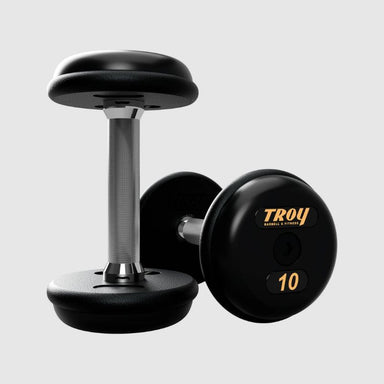
TROY TSD-U 12-Sided Urethane Encased Dumbbell
A versatile commercial option with a multi-sided shape that helps reduce rolling.
VTX 8-Sided Urethane Encased Dumbbells – SD-U
A useful choice for facilities wanting a stable, multi-sided urethane design.
TKO Strength 10-Sided Urethane Dumbbells – 830TU
A distinctive commercial urethane option for full gym sets.
TKO Strength Tri-Grip Urethane Hex Dumbbells – 816TXU
A practical option combining urethane heads with a grip-friendly design.
Hampton Fitness DBU DURA-BELL Urethane Hexagon Dumbbell
A Hampton option for gyms that prefer a hex-style profile.
Round Urethane Dumbbells
VTX Round Urethane Dumbbells – XD-U
A traditional round commercial design.
TKO Signature Round Urethane Dumbbell – 830US
A natural fit for facilities using TKO Signature equipment.
Intek Strength Armor Series Solid Urethane Dumbbells – DBSUT-PR
A strong choice for serious commercial strength rooms.
Intek Bravo Series Solid Urethane Dumbbells – DBSUB
Another Intek option for buyers who want solid urethane construction.
Escape Fitness Nucleus Urethane Dumbbells
A modern commercial option worth comparing for contemporary fitness spaces.
Custom Logo Urethane Dumbbells
Troy TSD-UL 12-Sided Urethane Dumbbell with Custom Logo
VTX XD-UL Round Urethane Dumbbells with Custom Logo
Intek Strength Custom Logo Armor Series Solid Urethane Dumbbells
TKO Strength Custom Logo Urethane Dumbbells
TKO Strength Custom Logo 10-Sided Urethane Dumbbells
These make the most sense when branding is part of the equipment plan rather than an afterthought.
Best Steel and Chrome Dumbbells from Dumbbells Direct
Solid Steel Dumbbells
York Professional Chrome Dumbbell with Ergo Grip – Solid Steel
A compact steel option with the familiar look of chrome.
Intek Strength Kraft RAW Series Steel Dumbbells – KSDB-PR
A strong match for strength facilities that want exposed-metal character.
Stainless Steel Dumbbells
Intek Strength Custom Logo Delta Series Stainless Steel Dumbbells
A branded stainless option for facilities wanting a distinctive metal presentation.
Chrome Dumbbells and Pro-Style Options
Hampton Chrome Beauty-Grip Dumbbells
Hampton Eclipse Chrome Pro-Style Dumbbells
TROY Pro Style HFD-C – Straight Handle & Chrome Endcaps
TROY PFD-C – Straight Handle & Chrome Endcaps
TROY HFDC-C – Contoured Handle & Chrome Endcaps
These fit gyms that still love the classic chrome and pro-style aesthetic.
Best Urethane Dumbbell Sets to Consider
Troy TSD-U 12-Sided Urethane Dumbbell Sets
VTX Round Urethane Dumbbell Sets – XD-U
TKO Strength 10-Sided Urethane Dumbbell Sets – 830TU
TKO Strength Signature Round Urethane Dumbbell Sets – 830US
Intek Strength Armor Series Solid Urethane Dumbbell Sets
Intek Bravo Series Urethane Dumbbell Sets
VTX XD-005-125U 5–125 lb Urethane Dumbbell Set
Choose the range based on actual member demand rather than buying heavy pairs that spend their entire life gathering dust.
Best Steel and Chrome Dumbbell Sets to Consider
Intek Strength Kraft Steel RAW Dumbbell Sets – KSDBSET
Intek Strength Custom Logo Kraft Steel RAW Dumbbell Set
Intek Strength Custom Logo Delta Series Stainless Steel Dumbbell Set
Hampton Chrome Beauty-Grip Dumbbells Set with Rack
Hampton Eclipse Chrome Pro-Style Dumbbells Set
Hampton Eclipse Chrome Pro-Style Dumbbells Set with Horizontal Rack
These deserve particular attention from strength gyms and clubs wanting a traditional metal free-weight area.
Urethane vs Steel Dumbbell Sets with Racks
Why buying the rack and dumbbells together can make sense
The rack is already matched to the size, weight range, and quantity of dumbbells.
5–50 lb dumbbell packages
A practical starting point for many smaller facilities.
5–75 lb dumbbell packages
This adds useful room for stronger members without jumping straight to a massive set.
5–100 lb dumbbell packages
A common target for full commercial gyms.
Heavy sets above 100 lbs
Plan extra rack space and a dedicated heavy-lifting zone.
Two-tier racks
Easy to access but often longer.
Three-tier racks
Helpful when you want to use vertical space.
Saddle racks
They give each dumbbell a defined home.
Vertical dumbbell racks
Useful for smaller sets and compact areas.
Which setup uses floor space most efficiently?
The answer depends on your exact weight range and head dimensions.
Urethane vs Steel Dumbbells for Custom Logo Gyms
Custom urethane logos
Urethane offers plenty of room for distinctive branded endcaps.
Custom steel and stainless steel logos
Metal dumbbells can also support attractive engraved or custom detailing.
Molded vs engraved branding
Each creates a different look and wear pattern.
Logo visibility
Large clear logos can make an entire rack feel custom-built for the facility.
Weight markings
Clear numbers make finding the right pair easier during busy workouts.
Brand colors
Some urethane programs allow additional visual customization.
Which material holds branding better over time?
The manufacturing method matters more than material alone.
Hotels, universities and branded commercial facilities
These are often the buyers who benefit most from custom-logo equipment.
Urethane vs Steel vs Chrome Dumbbells
Is chrome considered a steel dumbbell?
Chrome usually describes the finish, while steel describes the underlying material.
Solid steel vs chrome-plated steel
One refers to construction, the other to surface treatment.
Stainless steel vs chrome
Stainless is a material type; chrome is a finish.
Urethane-coated steel vs exposed steel
Both may use steel internally, but only one shields the head with urethane.
Which finish requires the least maintenance?
Urethane usually demands less cosmetic attention.
Which looks best in a commercial gym?
Urethane looks modern and polished. Steel and chrome look classic and serious.
Urethane vs Steel vs Cast Iron Dumbbells
Solid steel dumbbells
Compact and well suited to heavy training.
Cast iron dumbbells
A traditional, straightforward free-weight option.
Urethane-encased dumbbells
Better suited to facilities prioritizing appearance and floor protection.
Durability differences
Good construction matters across all three materials.
Floor protection
Urethane leads here.
Rust and maintenance
Exposed metal needs more attention.
Which provides the best commercial value?
Urethane suits broad commercial use, while steel or iron can make excellent sense in strength-oriented gyms.
Urethane vs Rubber Dumbbells
Urethane vs rubber coating
Both protect the dumbbell head, but they behave differently over time.
Durability
Urethane generally handles abrasion better.
Odor
Urethane typically has less noticeable odor.
Abrasion resistance
This is one of urethane’s strongest selling points.
Cleaning
Both are easy to clean when the right products are used.
Price
Rubber is generally more budget-friendly.
Are urethane dumbbells better than rubber?
For high-volume commercial use, often yes. For a tighter budget, rubber remains a sensible choice.
Urethane vs Hex Dumbbells: Is That the Right Comparison?
Urethane describes material
It tells you what covers or forms the head.
Hex describes shape
It tells you how the head is shaped.
Can a dumbbell be both urethane and hex?
Yes—and several commercial dumbbells are.
Urethane hex vs round urethane
Hex styles resist rolling, while round designs have the traditional commercial look.
Multi-sided urethane dumbbells
8-sided, 10-sided, and 12-sided heads provide another option between round and hex.
Which shape works best for commercial gyms?
Choose based on racks, exercises, storage, and the look you want.
Why Are Urethane Dumbbells So Expensive?
Material and manufacturing
Commercial urethane dumbbells require more processing than basic exposed-metal designs.
Molded urethane construction
Creating a durable molded exterior adds manufacturing cost.
Steel-core construction
The urethane is often protecting substantial internal steel construction.
Commercial durability
You are partly paying for equipment meant to handle years of traffic.
Cosmetic longevity
Looking presentable after thousands of uses has real commercial value.
Custom-logo manufacturing
Branding and custom molds can increase the price further.
Upfront price vs replacement frequency
A more expensive dumbbell can make sense if it needs replacing less often.
Are urethane dumbbells worth it?
For a busy commercial gym, they often are.
Urethane vs Steel Dumbbells for Different Facilities
General commercial gyms
Urethane is the strongest all-around choice.
Strength and bodybuilding gyms
Steel becomes much more appealing.
Athletic performance centers
Either can work depending on weight range and training style.
Personal training studios
Choose according to space, clientele, and flooring.
Boutique fitness studios
Urethane usually fits the visual environment better.
Schools and universities
Durability, warranty, and replacement costs should drive the decision.
Hotels and resorts
Urethane wins for noise control and presentation.
Apartment fitness centers
Urethane is easier to live with in a shared building.
Corporate wellness centers
Urethane provides an approachable, clean commercial look.
Which Option Is Better for Small Commercial Gyms?
Rack-space requirements
Measure the complete rack before placing an order.
Compact steel dumbbell heads
Steel can save valuable inches.
Floor protection with urethane
Urethane offers more forgiveness when space is tight.
Choosing a smaller weight range
Not every gym needs 100-pound dumbbells.
5–50 lb vs 5–75 lb vs 5–100 lb sets
Build around member demand rather than buying impressive weights nobody touches.
Which offers better value per square foot?
Steel wins on compactness; urethane often wins on broader usability.
Urethane vs Steel Dumbbell Maintenance
Cleaning urethane dumbbells
Use mild, appropriate cleaners and avoid abrasive products.
Cleaning steel dumbbells
Keep moisture from lingering on exposed metal.
Protecting chrome finishes
Avoid chemicals that may dull or damage the finish.
Preventing corrosion on steel
Control moisture and deal with damaged finishes early.
Inspecting handles and heads
Check for looseness, cracks, or movement.
Maintaining dumbbell racks
Inspect saddles, trays, contact points, and welds.
Which material is easier to maintain?
Urethane is generally easier from a cosmetic standpoint.
Urethane vs Steel Dumbbell Price & Overall Value
Why urethane dumbbells cost more upfront
Materials, molding, commercial construction, and branding options all contribute.
What affects steel dumbbell prices?
Steel grade, manufacturing, finish, handle design, and weight range all matter.
Chrome vs raw steel vs stainless steel pricing
Those finishes can sit at very different price points.
Complete dumbbell set cost
Budget for the entire run, not just your favorite pair.
Rack cost
The rack should be part of the initial equipment plan.
Flooring requirements
Steel may increase the importance of heavy-duty flooring.
Replacement costs
Think beyond the first invoice.
Long-term ownership cost
The least expensive set today is not automatically the cheapest set over ten years.
Buying complete commercial packages
Package purchases can simplify layout, shipping, and equipment matching.
Bulk pricing and custom quotes
Commercial buyers purchasing larger sets can inquire about custom discounts and package pricing.
What Should Gym Owners Check Before Choosing Urethane vs Steel Dumbbells?
Expected daily traffic
High traffic puts greater emphasis on abrasion resistance and maintenance.
Member demographics
Buy for your actual users.
Training style
General fitness and heavy bodybuilding create different requirements.
Maximum dumbbell weight needed
Decide where the set should realistically stop.
Head dimensions
Especially important for heavy dumbbells.
Handle diameter and knurling
These directly affect member comfort.
Weight accuracy
Commercial pairs should feel consistent.
Head-to-handle construction
This connection is crucial to long-term reliability.
Flooring
Match the dumbbells to what is underneath them.
Noise restrictions
Shared buildings need additional planning.
Rack compatibility
Do not assume every dumbbell fits every rack.
Available floor space
Leave room for members to stand and lift in front of the rack.
Cleaning requirements
Think about your daily maintenance routine.
Commercial warranty
Confirm that the warranty applies to your facility type.
Budget
Compare complete system cost, including racks.
Custom logo requirements
Plan branding before ordering rather than trying to add it later.
Which Dumbbells Direct Products Fit This Comparison Best?
Best Urethane Options for General Commercial Gyms
TROY TSD-U 12-Sided Urethane Dumbbells
VTX SD-U 8-Sided Urethane Dumbbells
TKO 830TU 10-Sided Urethane Dumbbells
TKO 830US Signature Round Urethane Dumbbells
Best Urethane Options for Strength Facilities
Intek Armor Series Solid Urethane Dumbbells
Intek Bravo Series Solid Urethane Dumbbells
VTX XD-U Round Urethane Dumbbells
Best Steel Options for Strength Facilities
Intek Kraft RAW Series Steel Dumbbells
York Professional Chrome Solid Steel Dumbbells
Best Custom Logo Options
Troy TSD-UL Custom Logo Urethane Dumbbells
Intek Custom Logo Armor Series Urethane Dumbbells
TKO Custom Logo Urethane Dumbbells
Intek Custom Logo Kraft Steel RAW Dumbbells
Intek Custom Logo Delta Stainless Steel Dumbbells
Best Complete Sets with Racks
TROY COMMPAC-TSDU50 5–50 lb Urethane Dumbbell Set with Rack
TROY COMMPAC-TSDU100 Urethane Dumbbell Set with Racks
TKO Tri-Grip Urethane Dumbbell Set with Rack
Hampton Dura-Bell Urethane Dumbbell Sets with Rack
Hampton Eclipse Chrome Pro-Style Dumbbell Set with Horizontal Rack
Should Your Gym Buy Urethane or Steel Dumbbells First?
When urethane should be the first choice
Choose it when traffic, noise, flooring, and presentation all matter.
When steel should be the first choice
Choose steel when heavy training and compact heads lead the priority list.
When chrome dumbbells make sense
Chrome works well when you want a polished, traditional weight-room look.
When custom-logo urethane is worth the investment
Brand-focused gyms can turn the dumbbell rack into part of the facility identity.
When a mixed dumbbell lineup can work
One practical approach is urethane through the general range and compact steel at the very heavy end.
Why flooring may decide the purchase
Hard metal places more demands on the training surface.
Why member demographics matter
A hotel fitness room should not be equipped exactly like a bodybuilding gym.
When budget should determine the decision
If urethane forces you to sacrifice useful weights, a quality steel or alternative set may be the smarter purchase.
Commercial Dumbbell Buying Checklist
Facility type
Expected daily traffic
Urethane vs steel construction
Weight range
Head shape
Head dimensions
Handle material
Handle diameter
Knurling
Weight accuracy
Floor protection
Noise
Rack compatibility
Available floor space
Cleaning and maintenance
Commercial warranty
Custom logo options
Budget
Future expansion
Think of these points as one buying decision rather than nineteen separate boxes. The right commercial dumbbell set should fit your members, room, rack, flooring, and long-term plans at the same time.
Frequently Asked Questions
What is the difference between urethane dumbbells and steel dumbbells?
Urethane dumbbells cover the weighted head with urethane, while steel dumbbells expose more of the underlying metal.
Which is better for commercial gyms: urethane or steel dumbbells?
Urethane usually works better for general commercial gyms. Steel is particularly strong for heavy strength environments.
Are urethane dumbbells worth it?
For a high-traffic facility that values appearance and durability, often yes.
Why are urethane dumbbells so expensive?
Material, molding, construction, commercial durability, and branding options increase manufacturing cost.
Are steel dumbbells good for commercial gyms?
Absolutely, particularly for strength and bodybuilding facilities.
Are chrome dumbbells made from steel?
Many are, although chrome describes the finish rather than guaranteeing a specific underlying construction.
Which lasts longer, urethane or steel dumbbells?
Both can last for years, but urethane often stays looking better through repeated rack contact.
Do steel dumbbells rust?
Some steels can corrode when exposed to moisture or when protective finishes become damaged.
Do urethane dumbbells damage floors?
They are more forgiving than exposed steel, but commercial flooring is still required.
Are steel dumbbells louder than urethane dumbbells?
Generally, yes.
Which dumbbells are better for heavy lifting?
Steel has an advantage in compactness, although commercial solid urethane lines also perform very well.
Which dumbbells are better for high-traffic gyms?
Urethane is usually the stronger choice.
Which option is best for small gyms?
Steel saves space through compact heads, while urethane provides better impact and noise management.
Is urethane better than rubber?
Urethane generally handles abrasion better, while rubber is usually more affordable.
Is urethane better than rubber-coated dumbbells?
For cosmetic longevity and heavy commercial wear, urethane often has the advantage.
Is urethane better than hex dumbbells?
That is not a direct comparison because urethane is a material and hex is a shape.
What should gym owners check before choosing urethane vs steel dumbbells?
Compare traffic, weight range, dimensions, handles, flooring, noise, racks, maintenance, warranty, and total cost.
Which Dumbbells Direct products fit this comparison best?
Strong urethane choices include TROY TSD-U, VTX SD-U, TKO 830TU, TKO 830US, Intek Armor, and Intek Bravo. For steel, compare Intek Kraft RAW and York Professional Chrome.
Final Verdict
Best for general commercial gyms
Urethane dumbbells.
Best for high-traffic facilities
Urethane for wear resistance, cleaning, and appearance.
Best for strength and bodybuilding gyms
Steel when compact heavy dumbbells are the priority.
Best for hotels and apartment gyms
Urethane for quieter use and better floor protection.
Best for heavy dumbbell training
Steel gets a slight edge for compactness.
Best for floor protection
Urethane.
Best for compact dumbbell heads
Steel.
Best for custom branding
Urethane offers an especially broad range of branded commercial options.
Best for long-term appearance
Urethane.
Best overall value
For most commercial gyms, urethane delivers the strongest combination of durability, appearance, member comfort, and floor protection.
Urethane vs steel dumbbells: which should your gym buy first?
Start with urethane if you run a health club, hotel, apartment gym, university, corporate fitness center, or other mixed-use facility.
If your gym lives at the heavier end of the dumbbell rack and your members care more about compact heads than quiet contact, steel deserves the first look.
Request a quote, bulk discounts & this week’s 5% coupon
Dumbbells Direct carries commercial urethane, steel, chrome, rubber, pro-style, and custom-logo dumbbells from TROY, VTX, TKO Strength, Intek Strength, Hampton Fitness, and other established brands.
If you are building a full dumbbell area, ask about current package pricing. Custom discounts may be available for complete sets, racks, custom-logo orders, and larger commercial gym purchases.
Dumbbells Direct also runs a rotating 5% discount on all orders each week using different coupon codes. Contact us to compare options, check current pricing, and find the best dumbbell setup for your facility.





Leave a comment